🎟️

A month of Learn Math for one child, on us.
Start with my coupon
עברית Start learning
Math for kindergarten to 3rd grade

Math that makes sense, a few minutes a day

Your child counts, adds, takes away, multiplies and shares with Duki the hoopoe, drawing tens as lines and ones as dots, just like in their school notebook. 98 short lessons, every instruction read aloud.

Invitation only · Google sign-in · no ads

98lessons
16chapters
22kinds of exercises
100adding and taking away up to 100
×÷times tables and sharing
∞fresh problems every time

What your child learns

One path in five steps, each building on the one before. Every chapter ends with a review. Children who already count or add skip ahead: you choose where they start.

Step 1Kindergarten

Numbers to 10

Meet each number, count things, find the number, and say which is more.

Numbers 1 to 5Numbers 6 to 10
Step 2Grade 1

Adding and taking away to 10

With pictures first, then with numbers. Ten frames and making ten, the base for everything that comes next.

Adding to 10Taking away to 10Make ten
Step 3Grades 1–2

Tens and ones

Read and build any number to 99 with lines and dots, then add and take away on the board: ten dots make a line, and a line breaks into ten dots.

Tens and onesAdding with lines and dotsTaking away with lines and dots
Step 4Grade 2

Adding and taking away to 100

Problems like 85 + 11 and 86 − 58, solved in the notebook with lines and dots, then in columns: carry the 1, borrow a ten, and hundreds too. Plus real-life story problems.

Adding to 100Taking away to 100Plus and minus to 100In columnsMath stories
Step 5Grade 3

Multiplication and division

Equal groups, arrays and skip counting, the times tables, sharing fairly, and stories about boxes, paying and sharing.

MultiplicationDivisionMore math stories

Two ways to solve, like at school

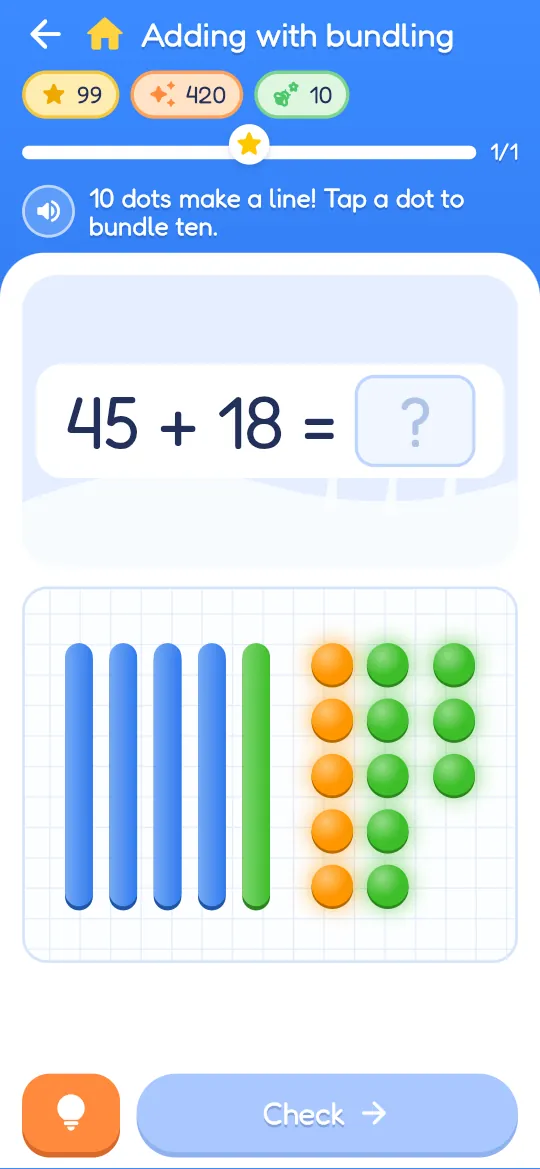
The same problem, 45 + 18, solved the way children draw it and the way it's written in columns. Learn Math teaches both, in that order, and shows how they match.

With lines and dots
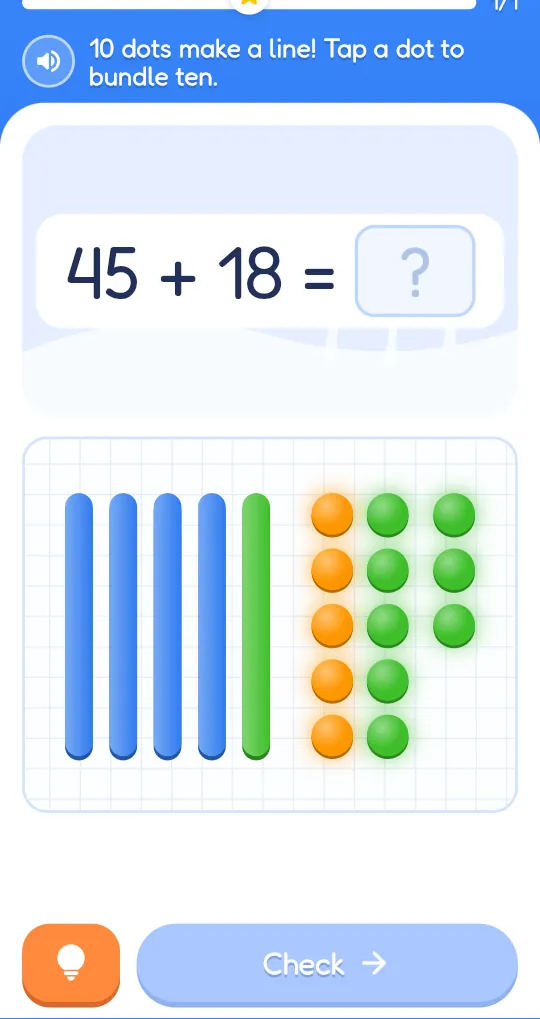
With lines and dots4 lines and 5 dots, then 1 line and 8 dots in green. 5 + 8 = 13 dots: ten of them make a new line. 6 lines and 3 dots: 63.
=Carrying the 1 is bundling ten dots into a line
In columns
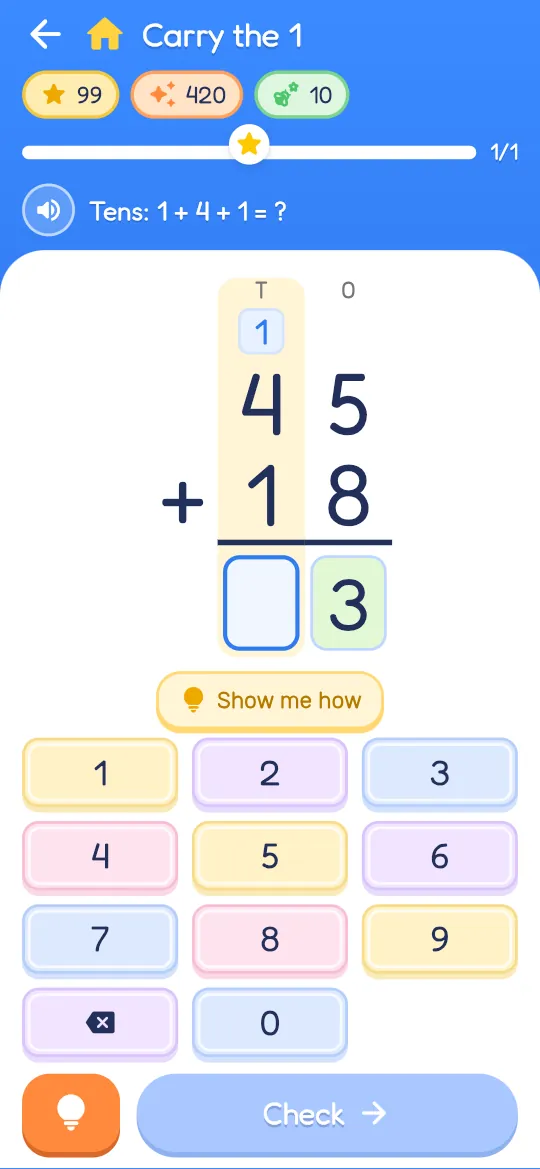
In columnsOnes first: 5 + 8 = 13. Write the 3, and carry the 1 to the tens. Tens: 1 + 4 + 1 = 6. The answer: 63.

Your child's class uses only one way? Choose lines and dots, columns, or both in the parents' area.

Exercises that feel like games

Every lesson mixes a few short exercises. Problems are made up fresh every time, so practice never runs out.

Meet the numbers

Meet the numbers

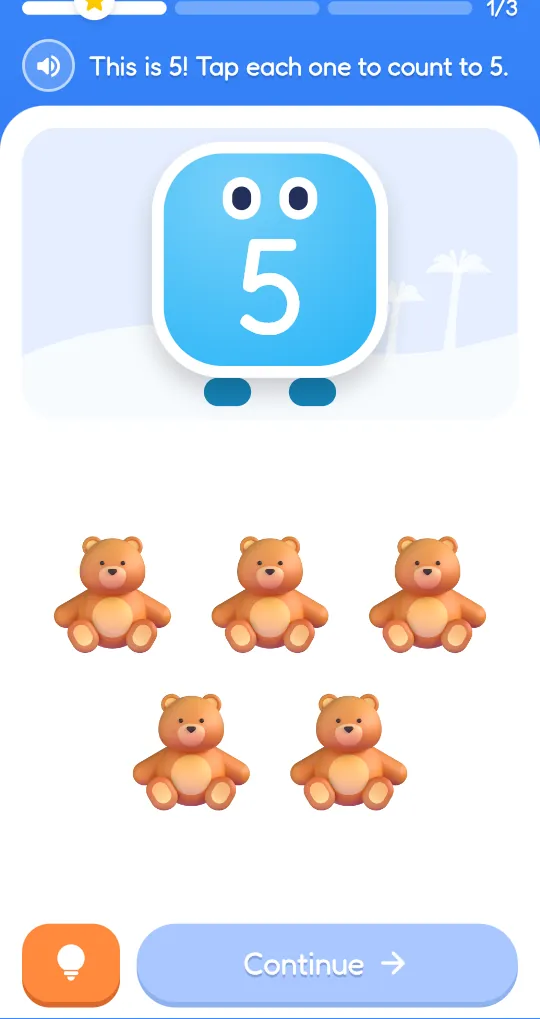
Each number is a friend: see it, count it, find it.

Make ten

Make ten

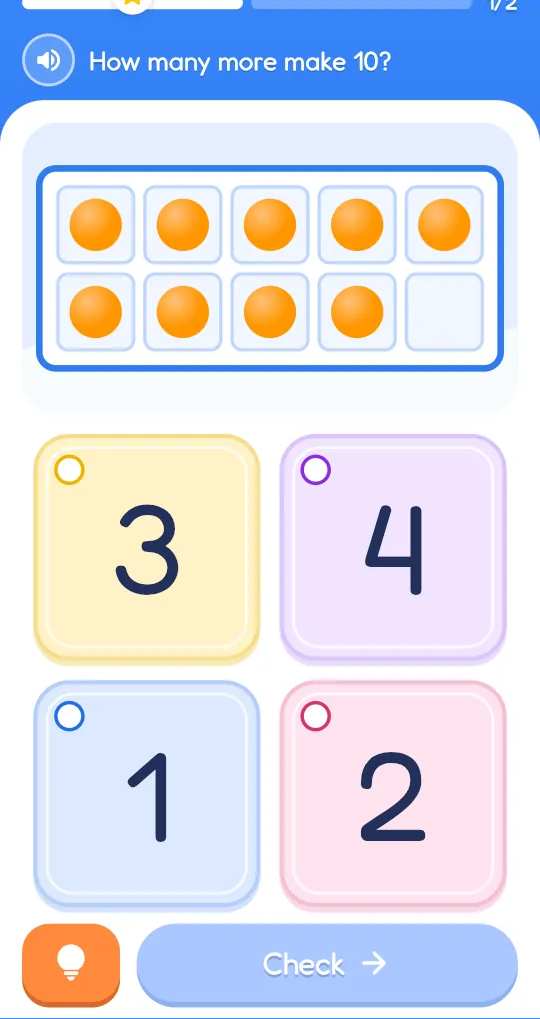
How many more to make ten? The key to adding fast.

Lines and dots

Lines and dots

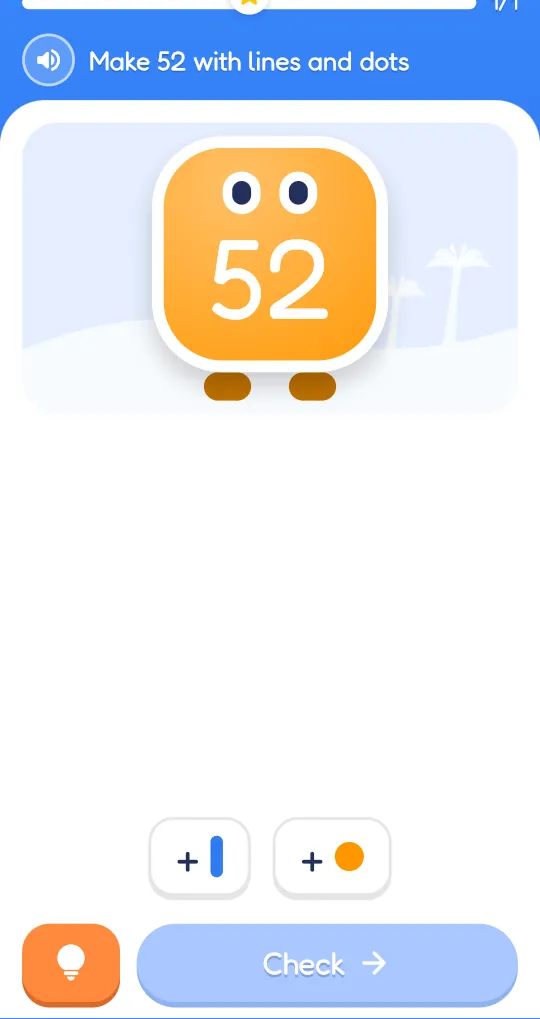
Build any number to 99: a line for each ten, a dot for each one.

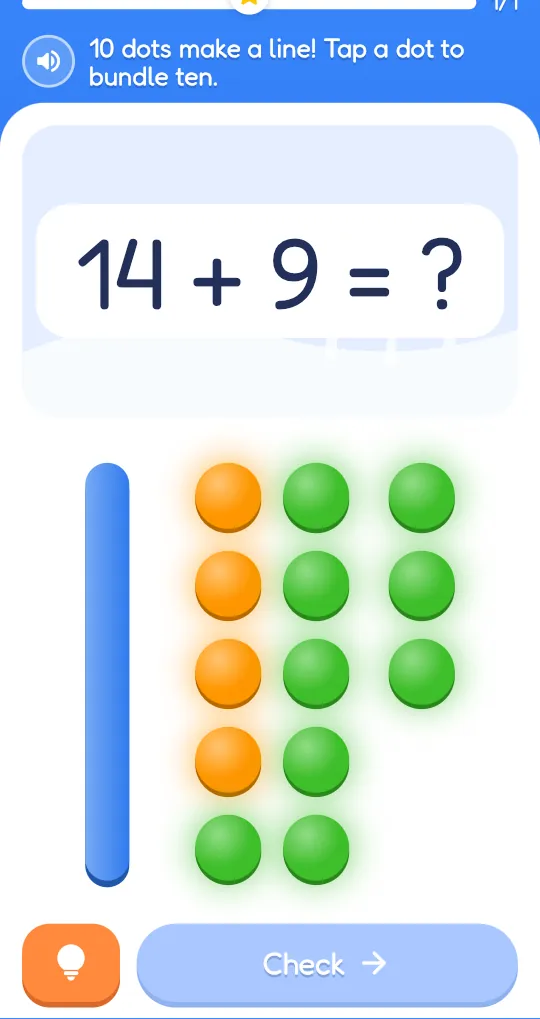
10 dots make a line

10 dots make a line

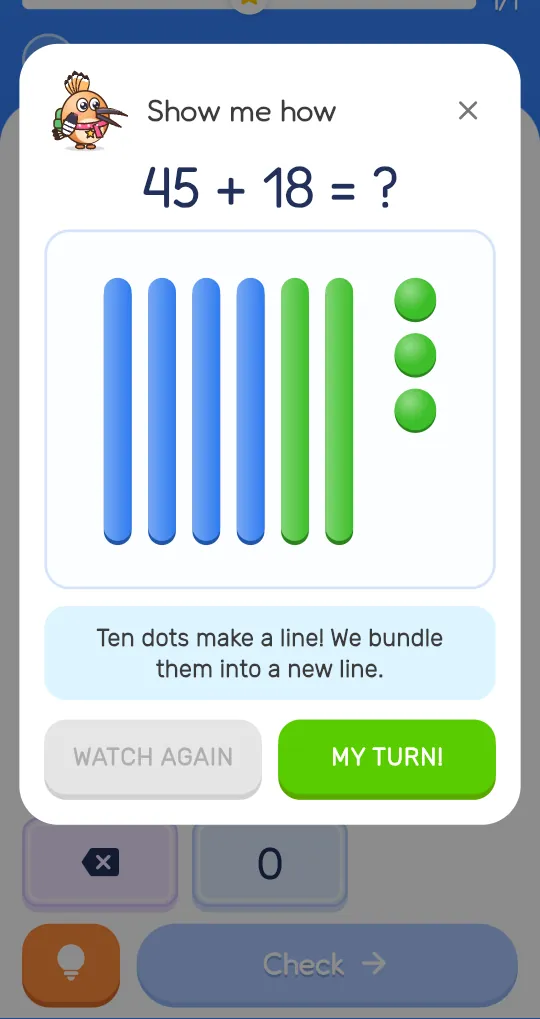
Adding with regrouping: tap to bundle ten dots into a line.

Break a line

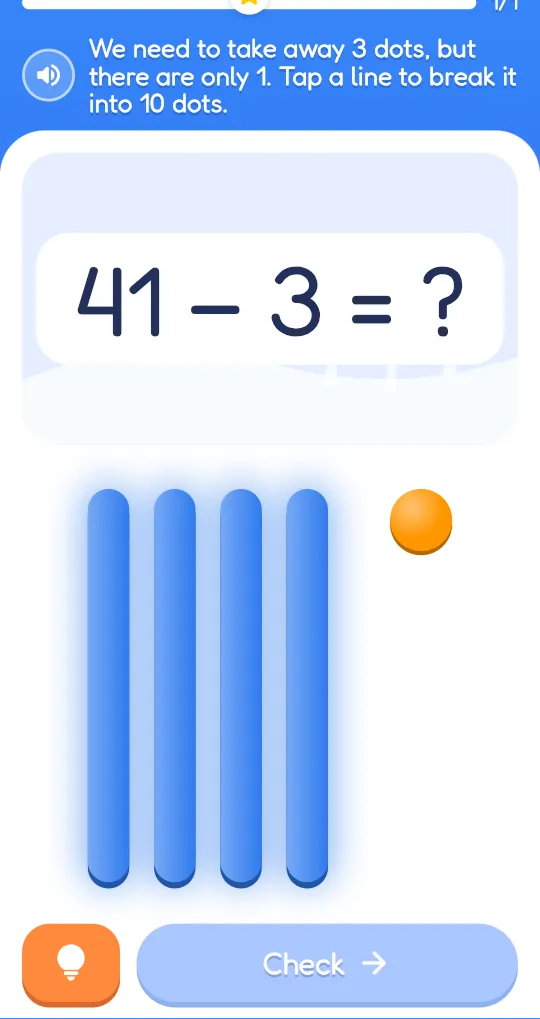
Break a line

Not enough dots to take away? Break a line into ten dots.

Just like the notebook

Just like the notebook

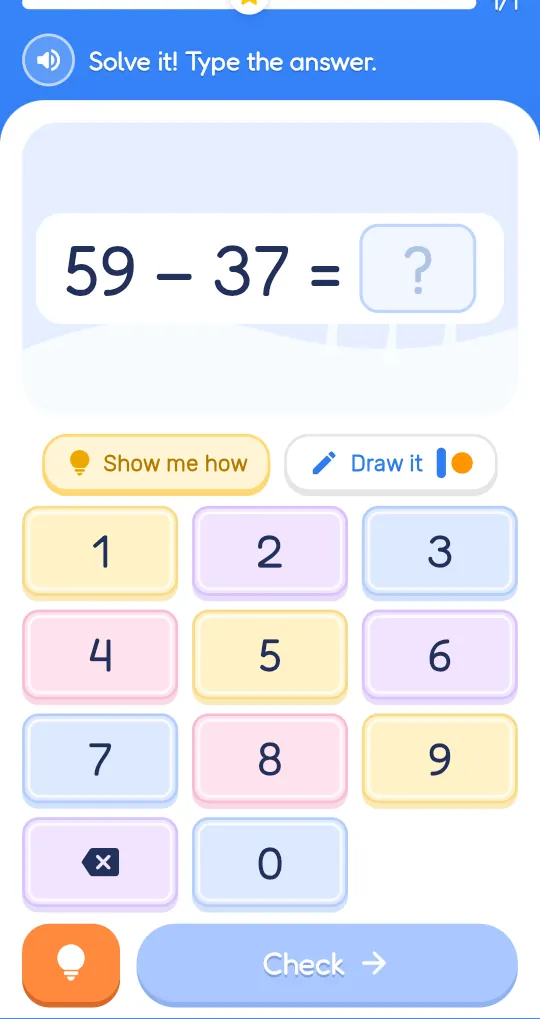
Draw the lines and dots, cross out, step by step, then write the answer.

In columns

In columns

Ones under ones: carry the 1 and borrow a ten, with lines and dots beside it.

Try it on their own

Try it on their own

No hints until they ask. Help me and Show me how are one tap away.

Equal groups

Equal groups

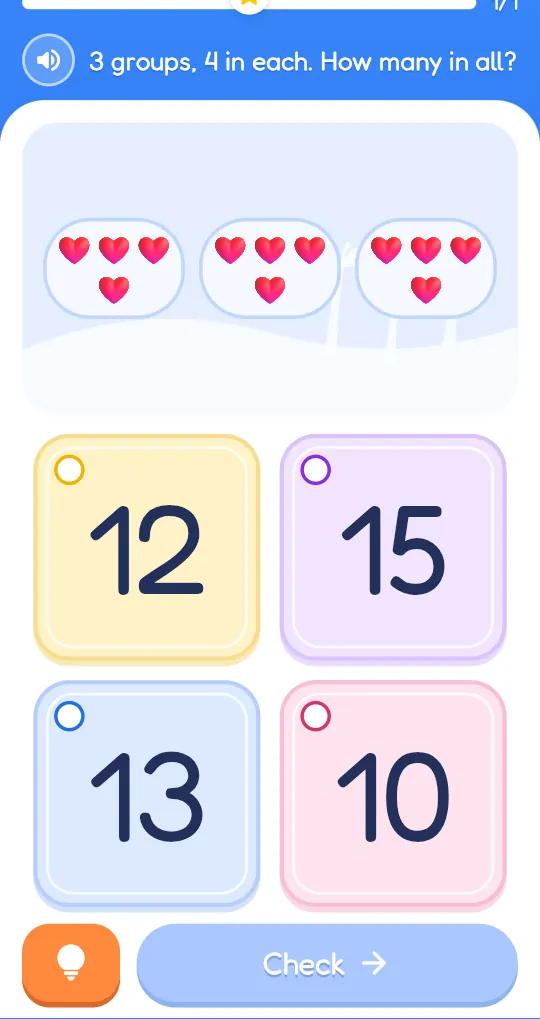
3 bags of 4 apples: see what multiplication means.

Show me how

Show me how

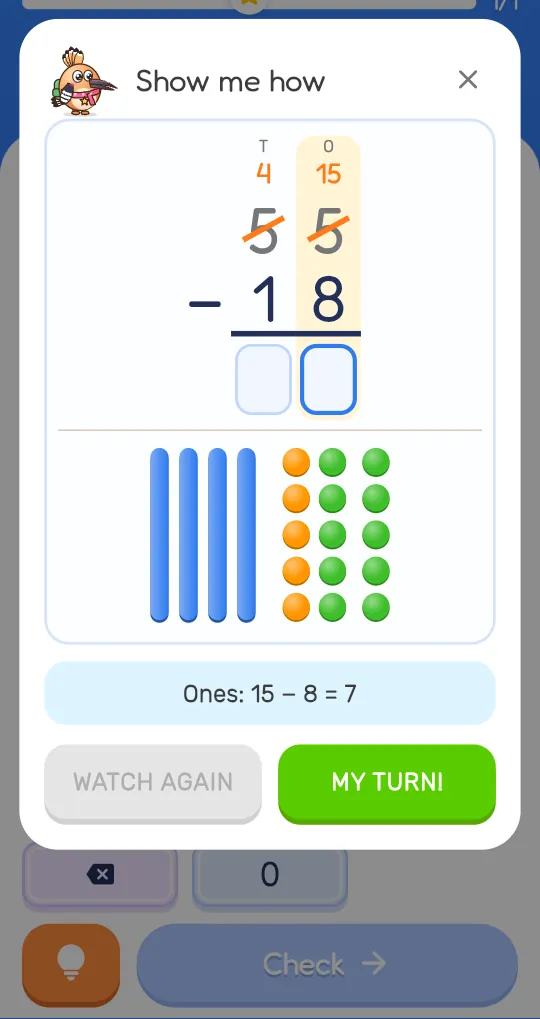
Stuck? Duki plays the whole solution with lines and dots, one step at a time.

Share fairly

Share fairly

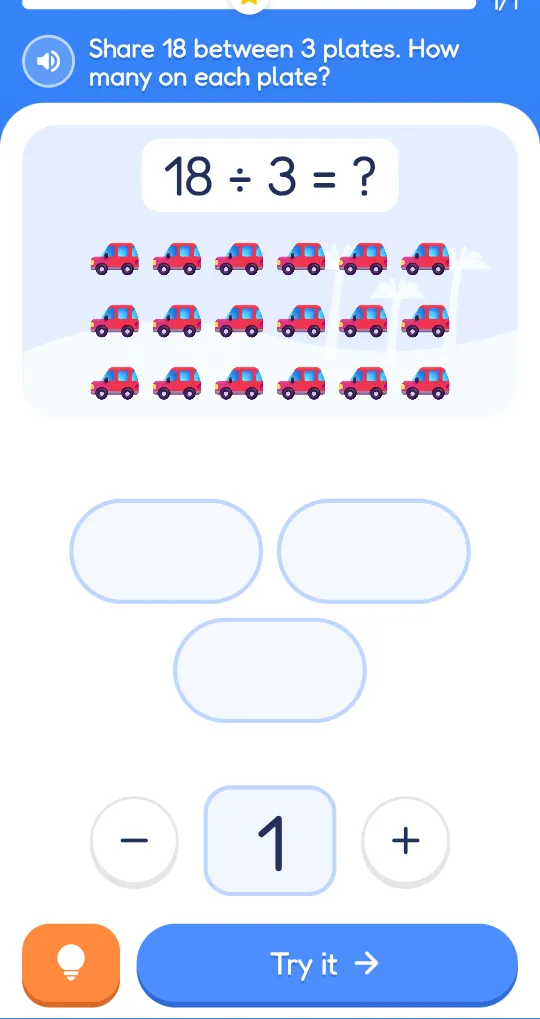
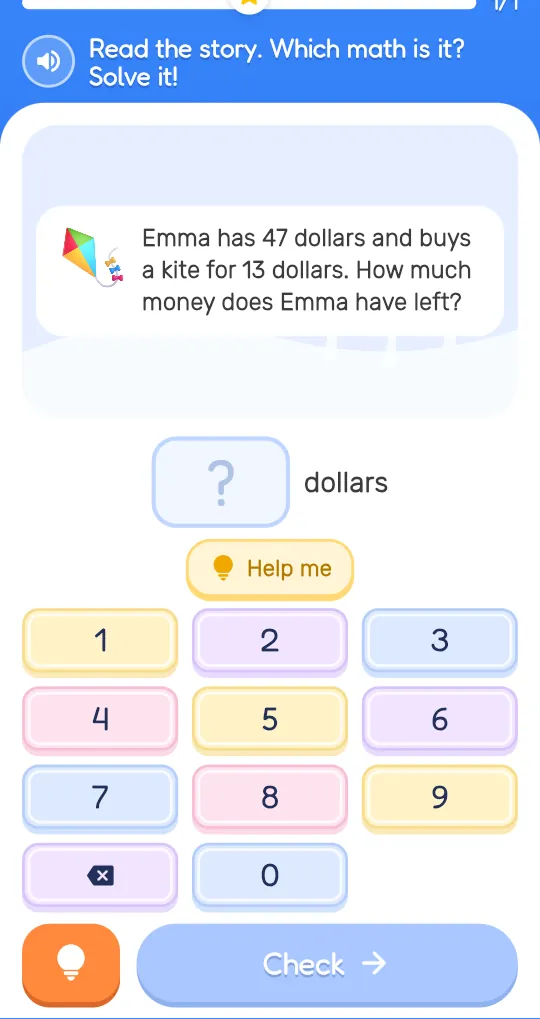
20 cookies, 4 plates: guess how many on each, then check.

Story problems

Story problems

Real life: shopping, paying, sharing and comparing.

And more: how many?which is morefind the numberten framesread a numberarraysmaking groupsskip countingtimes tablesdivision factsmixed problemschapter reviewsnumber pad answers

Help only when they need it

💡

Try first, help on request

Children try on their own. A hint, a step-by-step guide or a Show me how animation is there when they ask for it.

🔊

Every instruction read aloud

Friendly voice in English or Hebrew, so young children don't need to read yet.

⭐

Stars and a friend who grows

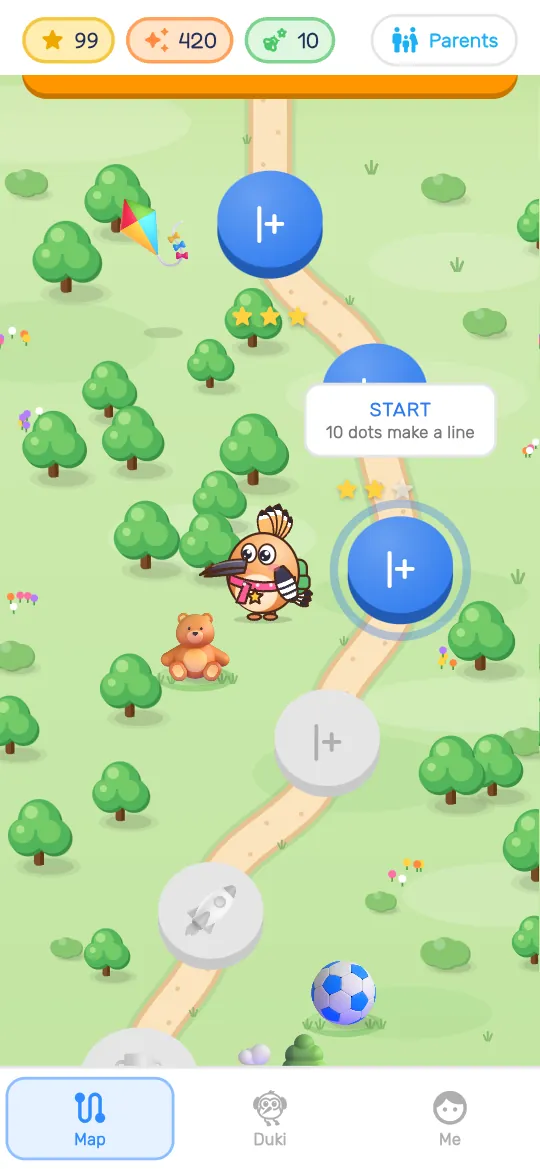
Up to 3 stars a lesson. Duki earns a scarf, a backpack and a medal along the way.

🤝

Practice together

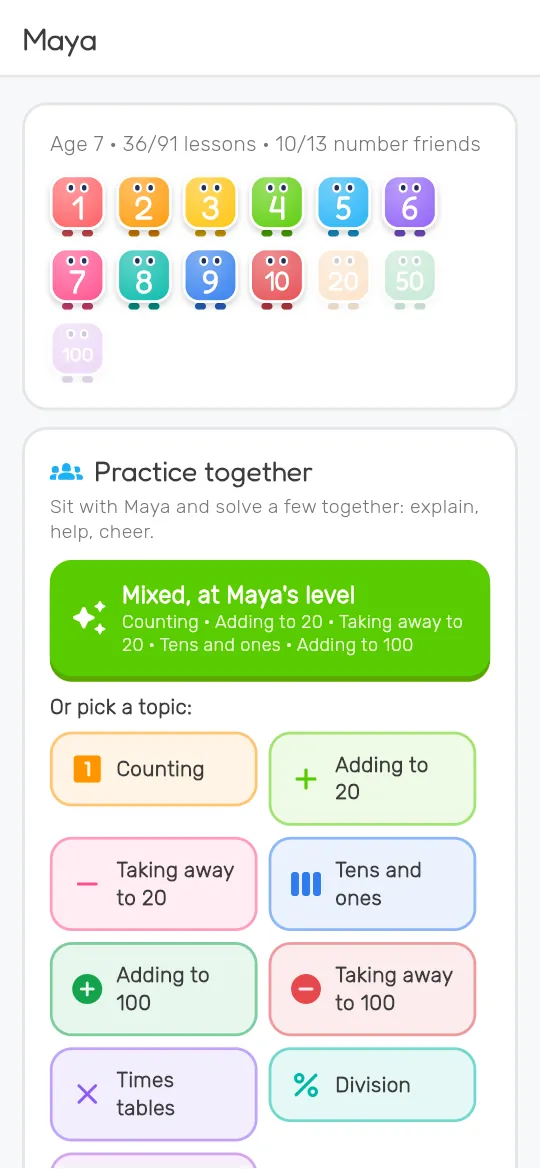
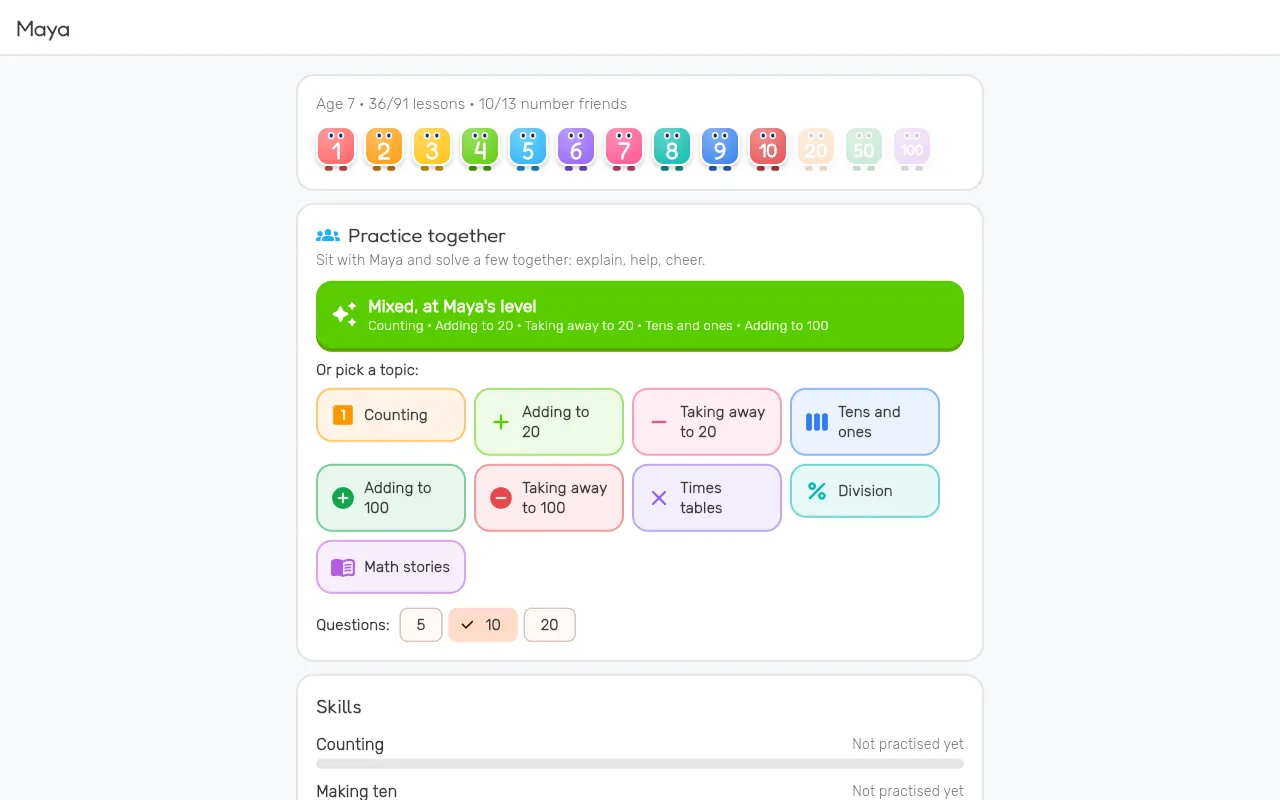
Parent-and-child time: pick a topic or a mix for their level, 5, 10 or 20 questions, and explain as you go.

For parents: see exactly where they are

  • Lessons done, stars and skills for each child
  • Every skill at a glance: counting, adding, taking away, tens and ones, columns, times tables, division
  • Lines and dots, columns, or both: choose the way your child's class solves
  • Practice together: choose the kind of questions and how many
  • Start where your child is, and change it anytime
  • Several children in one family, each at their own pace
  • English or Hebrew, with boy, girl or neutral wording
  • One Google sign-in for the family. Children never sign in. No ads, ever

Less than one private lesson a month

A private math tutor often costs about $500 a month for two 1-hour lessons a week. Learn Math is practice every day, for $20 a month.

Private tutor

$500
a month, 2 lessons a week
  • About $60 for each 1-hour lesson
  • Fixed times, travel or video calls
  • One child per lesson

Learn Math

$20
per child, per month
  • Every day, as much as they like
  • Anytime, on any device
  • 98 lessons, 22 kinds of exercises, new problems every time
  • A whole month costs less than half of one tutor lesson

Great on its own, and great between lessons with a teacher or tutor. Learn Math is invitation only: sign in, tell us about your family, and we'll be in touch.

Questions parents ask

What ages is it for?

Children from about 5 to 9, kindergarten to 3rd grade: from counting to 10 all the way to adding and taking away within 100, times tables and division.

Is it the way they learn at school?

Yes. Adding and taking away follow the order taught in US schools (Common Core): look at the ones first, bundle ten ones into a ten, and break a ten when there aren't enough ones. Children draw tens as lines and ones as dots, the same drawing many teachers use, and then solve in columns (the standard method). If your child's class uses only one way, choose it in the parents' area.

My child can already count and add. Do they start from the beginning?

No. When you add a child you choose where they start: counting, adding to 10, tens and ones, two-digit problems or times tables. You can change it later in the parents' area.

Does it give the answer away?

No. Most exercises start without help. If your child is stuck, a Help button guides them one step at a time, and Show me how plays the whole solution with lines and dots.

Can we use it in Hebrew?

Yes. Every screen and every spoken instruction is in English or Hebrew, and you can switch anytime.

How do we get access?

Learn Math is invitation only. Sign in with Google, tell us your name, group and how many children will learn, and we approve families ourselves. Got a coupon? Use it when you sign up and start right away.

How much does it cost?

$20 per child per month. When we approve your family we'll tell you how to pay. Families with a coupon start for free.

Do children need their own account?

No. One parent signs in with Google; you add each child by first name. Children never sign in or type an email.

Which devices does it work on?

Phones, tablets and laptops, in any modern browser. Add it to the home screen and it works like an app, even offline.
Ready when they are

Sign in with Google and tell us about your family. It takes a minute.

Start learning